
Residential @ The Prestige Place Unit Mix
The brief positions the township for a wide buyer base rather than a single niche. Apartment sizes are only indicative until formal plans are issued.Residential @ The Prestige Place Floor Plan Cards
Use these visuals for early orientation only. Final RERA carpet area, balcony treatment, loading, facing, and tower stack should be checked in official documents.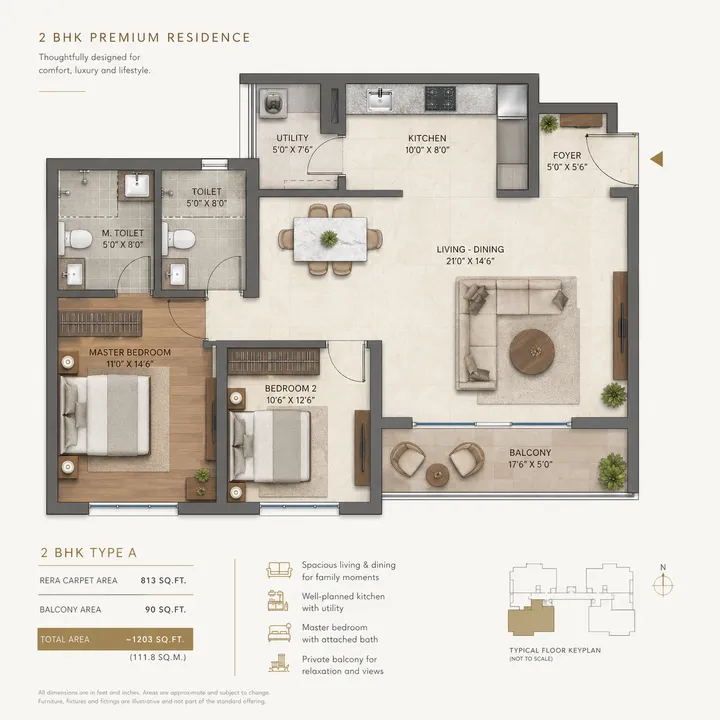
2 BHK Apartment
Best suited for compact end-use and rental demand if the final carpet efficiency works well. Because both projects sit inside the Prestige Group portfolio, Prestige Avon helps readers separate brand trust from city-specific pricing, location, and possession questions.
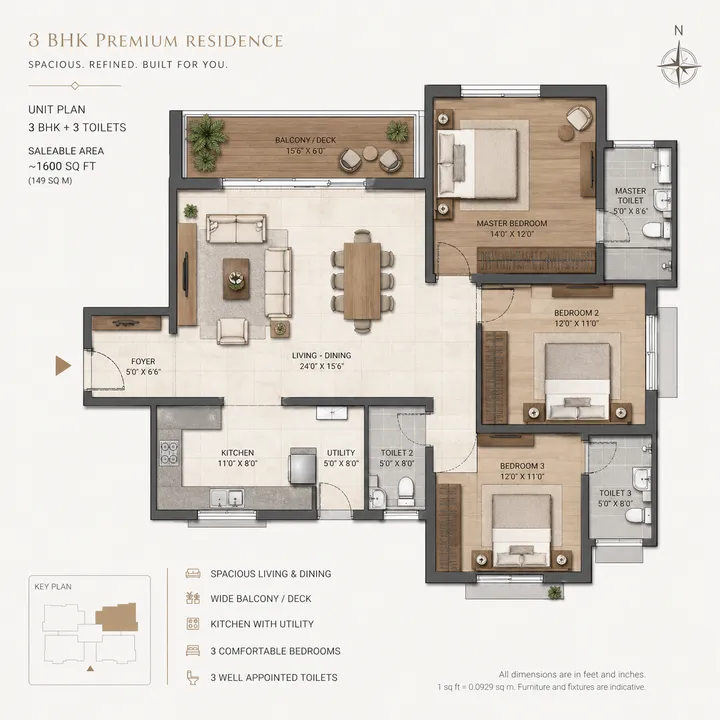
3 BHK Apartment
Likely the main family format; compare bedroom sizes, kitchen utility, and balcony placement.
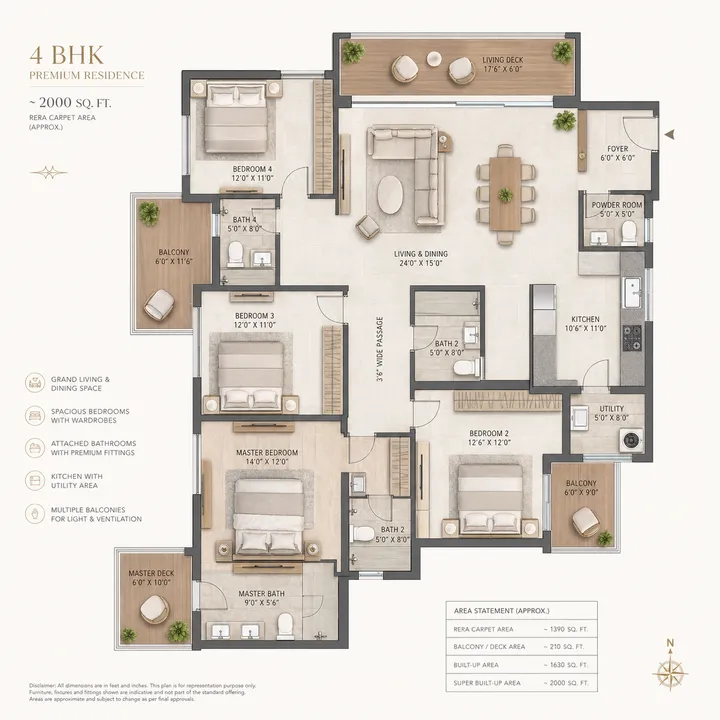
4 BHK Apartment
Premium format for upgrade buyers; verify privacy, servant space, and lift lobby relationship.
Size Details
The source notes conflicting early size references across public pages. Treat every size band as indicative until RERA carpet area and saleable area are published.
Villas And Plots
Villas and plots are mentioned, but no reliable matrix of plot dimensions, villa types, or building guidelines is available yet.
Before Choosing
Ask for plan dimensions, carpet-area statement, direction, view, tower distance, floor level, parking, and common-area loading.
Residential @ The Prestige Place Layout Guidance
Floor plans are where the marketing promise becomes practical living. Residential @ The Prestige Place currently has local assets for 2 BHK, 3 BHK, and 4 BHK apartment layouts, while the brief also mentions 1 BHK apartments, villas, and plots. Because final RERA carpet areas and approved plans are awaited, the right way to use this page is to learn what to inspect when the official plans arrive.
For a 1 BHK buyer, the key issue is usable efficiency. The brief references 450-550 sq ft as an early size estimate, but it does not confirm whether that is carpet, saleable, or super built-up. A compact Mumbai 1 BHK can work well if the living area is not eaten by passage space, the bedroom can hold a proper bed and wardrobe, the kitchen has practical counter length, and the bathroom is not awkwardly placed. If the plan is efficient, the lower ticket size can create strong rental and resale interest.
For a 2 BHK buyer, think like an end user even if you are investing. The second bedroom must be usable, not token. Check whether it can fit a bed, desk, and wardrobe. Check whether the kitchen has a utility or at least a functional service edge. Check whether the living room has a real dining position. In many Mumbai layouts, the difference between a comfortable 2 BHK and a cramped 2 BHK is not the total area; it is the planning of corners, doors, and circulation.
For a 3 BHK buyer, the layout must support family life. I look for bedroom separation, a sensible guest bathroom location, kitchen privacy, balcony access, and whether the third bedroom is truly useful. A 3 BHK in the 1,100-1,500 sq ft indicative range could serve different buyer profiles depending on the final plan. The smaller end may suit a compact family, while the larger end may appeal to upgrade buyers who want a more premium feel.
For a 4 BHK buyer, the plan should justify the premium. At this level, buyers should expect better privacy, more generous bedrooms, a strong living-dining zone, utility planning, and at least one flexible room use. Ask whether the 4 BHK has servant space, powder room, separate utility, and enough storage. The Rs 3.80 crore onwards estimate makes layout quality extremely important because any inefficiency becomes expensive.
Balcony placement is not a small detail. A balcony attached only to a bedroom serves a different lifestyle than a balcony connected to the living area. A balcony facing future construction may not feel premium even if the unit is higher. If the project has views toward green zones, clubhouse, internal roads, or future phases, compare those views with price premiums. Do not pay view premium unless the view is protected by the master plan.
Carpet area and loading must be checked line by line. Buyers often compare saleable area because that is how early estimates are discussed, but the lived value comes from carpet area. Ask for RERA carpet, balcony area, utility area, and common-area loading. Then calculate whether the price per usable sq ft still makes sense. This is especially important in a township where clubhouse and common amenities can create higher common-area allocations.
Tower stack and floor level matter. A good plan on the wrong stack can face heat, noise, construction, another tower, or service areas. Ask for direction, tower distance, lift position, refuse shaft, staircase, fire escape, and service duct location. If the project has multiple phases, check whether your view or access will be affected by later construction.
Villas and plots need a different plan review. A villa buyer must verify land area, built-up area, setbacks, private garden, parking, floor count, terrace rights, and maintenance obligations. A plot buyer must ask for road width, plot dimensions, facing, utility connection points, development guidelines, and title structure. Since the brief does not provide a reliable matrix, these formats should be evaluated only after official release.
My floor-plan advice is to shortlist two or three configurations, not one. Once the formal plans are released, compare them by room usability, carpet efficiency, light, ventilation, privacy, and all-in price. The best unit is rarely the cheapest unit. It is the unit where the plan, floor, view, payment schedule, and resale logic line up.
The safest way to read Residential @ The Prestige Place is to separate project potential from project proof. Potential comes from the Prestige Group name, the Mumbai location story, the 115-acre township positioning, and the apartment, villa, and plot mix. Proof will come from MahaRERA registration, sanctioned drawings, the promoter entity, carpet-area statements, final cost sheet, payment schedule, and the registered list of amenities. Until those documents are visible, my advice is to shortlist with interest but decide with restraint.
This agent-led approach is important because early real estate communication often uses broad corridor names, indicative sizes, and projected prices. Those inputs are helpful for research, but they are not the same as a registered launch. Buyers should keep a note of every claim they care about and ask where it appears in the official document set. If a claim is not in the brochure, RERA record, agreement, or cost sheet, treat it as guidance rather than a binding promise.
Layout Guidance Checklist
What to verify about the layouts before treating any plan as final.
Document Check
Ask for MahaRERA registration, sanctioned plans, promoter details, legal title, phase boundaries, and the draft agreement before paying any non-refundable amount.
Commercial Check
Compare base price, all-in cost, payment schedule, cancellation terms, maintenance assumptions, and loan availability for the exact unit or product type.
Lifestyle Check
Map the final location, commute, tower or plot position, amenity access, construction phasing, and everyday usability for your household.
Residential @ The Prestige Place Plan Selection Framework
A plan should be judged by how it works at 8 AM, not how it looks on a brochure. Where does a child study? Where does a guest sit? Where is the washing machine? Can groceries move from the door to the kitchen without crossing the living room awkwardly? Is there a place for shoes, cleaning supplies, luggage, and work-from-home equipment? These everyday questions reveal plan quality.
Light and ventilation are equally important. In Mumbai, cross ventilation can be limited in high-rise layouts, so window placement and shaft design matter. Ask whether kitchens and bathrooms ventilate naturally or mechanically. Ask whether bedrooms share a shaft view or open to a more pleasant side.
Noise should be checked before choosing a stack. Units near podium activity, clubhouse, sports courts, entry roads, service zones, or future construction can experience more disturbance. Higher floors may reduce some noise but can increase wind or heat exposure depending on orientation.
For families, the best plan is often not the largest plan but the most balanced plan. A slightly smaller apartment with less passage waste can live better than a larger one with poor room proportions. Ask for dimensioned plans, not just area statements.
For resale, choose layouts that appeal to the broadest buyer pool. Practical 2 and 3 BHK layouts usually have wider liquidity than unusual plans. Premium 4 BHK layouts can work well when they feel genuinely spacious and private.
From a trust standpoint, the biggest service a real estate agent can provide here is not excitement; it is sequencing. Residential @ The Prestige Place should first be screened for concept fit, then document fit, then budget fit, and only then unit fit. If you reverse that order and fall in love with a render or a starting price, you may miss the legal and commercial questions that protect you.
The practical documents to request are straightforward: MahaRERA registration, sanctioned layout, promoter details, land title summary, phase boundary, carpet-area statement, official price sheet, other charges, payment schedule, cancellation terms, draft agreement, amenity schedule, and construction timeline. Once those are available, compare every sales claim against them.
The local-market question is equally important. Kanjurmarg-Mulund is a credible broad location, but final value will depend on the exact pin, approach road, station access, highway route, future metro influence, and the tenant or end-user catchment around Powai, Vikhroli, Airoli, Mulund, and Thane-side employment.
A strong pre-launch decision is never based on one metric. Brand without documentation is not enough. Low price without good layout is not enough. Amenities without maintenance clarity are not enough. Location without exact access is not enough. The project becomes compelling only when these pieces line up.
This is also why the current pages keep using words like indicative, awaited, expected, planned, and verify. Those words are not weakness. They are accuracy. They help buyers understand what is known today and what must be confirmed before booking.
Residential @ The Prestige Place Final Buyer Notes
My final working rule for Residential @ The Prestige Place is to keep enthusiasm tied to evidence. The project has the right ingredients for a serious Mumbai township conversation: Prestige Group, the Kanjurmarg-Mulund belt, apartment choices, villas, plots, a large land parcel, and a lifestyle-led plan. Those ingredients justify attention. They do not replace verification.
Before booking, build a simple file with every document and every answer. Save the brochure, RERA link, sanctioned plan, cost sheet, unit plan, payment schedule, maintenance estimate, location pin, and written sales communication. Then compare the file with your own priorities: budget, commute, school access, possession timeline, family size, rental expectation, and exit plan. If a priority is not supported by documents, treat it as unresolved.
This approach is especially important for buyers evaluating from outside Mumbai or from overseas. Do not depend only on a phone call or a render. Ask for document-backed answers, schedule a physical or video review, and compare the project with alternatives that are already launched. Residential @ The Prestige Place can remain high on the shortlist, but the final decision should be made only when legal, commercial, planning, and lifestyle evidence align.
One final practical point: the best buyers do not wait passively for launch. They prepare their comparison set early, decide their maximum all-in budget, list non-negotiables, and define what would make them walk away. For Residential @ The Prestige Place, those walk-away points may include unclear RERA status, weak carpet efficiency, excessive launch premium, inconvenient approach road, delayed amenity delivery, or poor separation between residential and mixed-use movement. Writing those limits down before the sales cycle begins helps buyers stay rational when inventory opens.
Residential @ The Prestige Place Floor Plans FAQs
What floor plans does Residential @ The Prestige Place offer?
Current local assets cover 2, 3 and 4 BHK apartment layouts, while the brief also references 1 BHK apartments, villas, and plots. The official floor plan pack will be released with the launch brochure and MahaRERA filings.
What is the indicative size of a 1 BHK at Residential @ The Prestige Place?
The brief lists a 1 BHK apartment range of roughly 450 to 550 sq ft. This is an early estimate; carpet area, balcony allocation, and per-unit availability will be confirmed only when the official plan pack is released.
What is the indicative size of a 2 BHK at Residential @ The Prestige Place?
The brief references a 2 BHK band of about 750 to 950 sq ft. The number is indicative and should be checked against approved drawings and carpet-area statements before booking.
What is the indicative size of a 3 BHK at Residential @ The Prestige Place?
The brief points to a 3 BHK band of roughly 1,100 to 1,500 sq ft. 3 BHK buyers should focus on kitchen utility, passage efficiency, bedroom privacy, and balcony placement once the formal plans are out.
What is the indicative size of a 4 BHK at Residential @ The Prestige Place?
The brief lists a 4 BHK band of about 1,800 to 2,500 sq ft. Buyers in this segment should examine family living space, guest movement, storage, and whether proportions genuinely match a premium positioning.
Are the villa and plot layouts at Residential @ The Prestige Place public yet?
Villa typologies, plot dimensions, and per-format pricing are not yet disclosed and remain on request. Their layouts, road widths, and building guidelines will be shared as the phased release approaches launch.