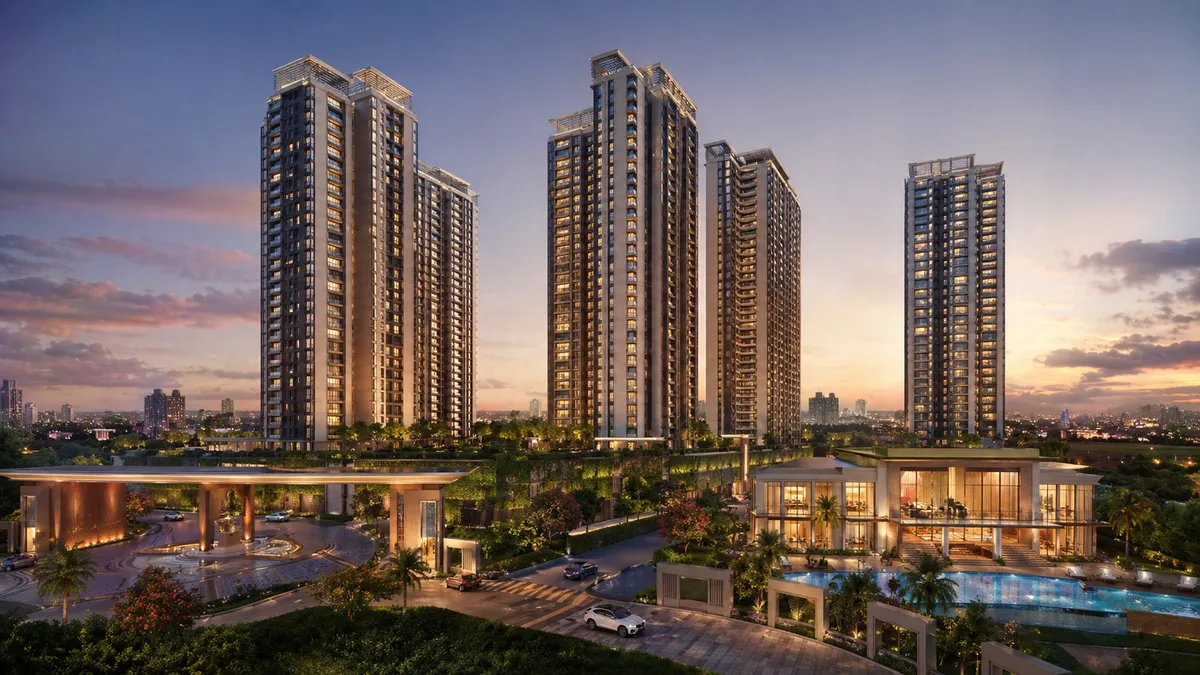
Residential @ The Prestige Place pricing should be read as a budgeting framework, not as a final rate card. The current brief lists indicative starting points: Rs 85 lakh onwards for 1 BHK, Rs 1.45 crore onwards for 2 BHK, Rs 2.40 crore onwards for 3 BHK, and Rs 3.80 crore onwards for 4 BHK. Villas and plots are on request. These numbers are useful because they tell buyers where the project may sit in the market, but they are not enough to calculate the real purchase decision. For buyers tracking Prestige options in Mumbai, Prestige Horizon Heights keeps the shortlist grounded in local commute, pricing, and possession assumptions.
In Mumbai, the difference between base price and all-in price can be significant. A buyer must add GST where applicable, stamp duty, registration, parking, floor rise, preferred location charges, clubhouse deposits, maintenance advance, legal charges, corpus, and any township-level infrastructure charges. A Rs 1.45 crore headline for a 2 BHK is not the same as the cheque you will write. The proper question is: what is the final agreement value, what is the total payable before possession, and what are the recurring monthly costs after possession?
For a 1 BHK buyer, the main pricing question is entry value. If the project launches near the current estimate, it could interest buyers who want a branded Mumbai address at a lower ticket size. But a 1 BHK works only when the carpet area, layout efficiency, and rental catchment justify the total price. Ask whether the 450-550 sq ft size reference is carpet, saleable, or super built-up. That one clarification changes affordability.
For a 2 BHK buyer, pricing must be compared with both end-use comfort and liquidity. A 750-950 sq ft estimate can mean very different lived experiences depending on loading, balcony treatment, passage loss, and bedroom dimensions. If you are buying for family use, do not choose only by the lowest quoted starting price. Ask for the exact unit plan, floor, view, parking, and all-in value. If you are buying for rent, compare likely tenant demand from Powai, Vikhroli, Kanjurmarg, Mulund, Airoli, and nearby office corridors.
For a 3 BHK buyer, the current estimate of Rs 2.40 crore onwards should be tested against family utility. A good 3 BHK in Mumbai should support a master bedroom, two usable secondary bedrooms, storage, a practical kitchen, and a living-dining area that does not feel compromised. If the all-in price becomes significantly higher after floor rise and charges, compare it with ready or under-construction 3 BHK options nearby. Paying a brand premium is fine when layout, delivery, and township quality support it.
For a 4 BHK buyer, the Rs 3.80 crore onwards estimate places the project in an upgrade segment. These buyers should not make decisions on price per sq ft alone. They should study privacy, lift lobby relationship, servant or utility space, bedroom proportions, view, parking count, and whether the tower has the right premium feel. In larger homes, poor planning is more expensive because the absolute ticket size is high.
Villas and plots require a separate pricing method. A villa buyer needs land component, built-up area, specification, private open space, parking, and maintenance structure. A plot buyer needs plot dimensions, title, road width, development charges, building guidelines, registration structure, and whether construction is mandatory within a certain timeline. Since the current brief does not provide these details, villas and plots should remain on-request categories until formal release.
Payment schedule is as important as price. Ask whether the project uses construction-linked, time-linked, subvention, or special launch-stage payment plans. A low starting price with an aggressive payment schedule can strain cash flow. A slightly higher price with a balanced construction-linked schedule may be safer. Also ask how cancellation works, when allotment happens, whether EOI is refundable, and what happens if final price differs from the estimate.
For loan planning, wait for bank approvals and RERA details. Lenders generally need legal clarity, project registration, and technical documents before disbursal. If you are dependent on home loan funding, do not assume eligibility only because the developer is known. Ask whether the exact residential phase is approved by banks, what margin money is required, and whether villas or plots have a different loan structure than apartments.
The best pricing comparison is not against one competing project. Create a small matrix: launched projects in Mulund, Kanjurmarg, Powai-edge, Vikhroli, and Airoli-linked corridors; ready projects with higher ticket but lower risk; under-construction projects with clearer RERA timelines; and this pre-launch township with potentially better entry but more unknowns. Compare all-in cost, possession, carpet area, brand, amenities, maintenance, and resale story.
The safest way to read Residential @ The Prestige Place is to separate project potential from project proof. Potential comes from the Prestige Group name, the Mumbai location story, the 115-acre township positioning, and the apartment, villa, and plot mix. Proof will come from MahaRERA registration, sanctioned drawings, the promoter entity, carpet-area statements, final cost sheet, payment schedule, and the registered list of amenities. Until those documents are visible, my advice is to shortlist with interest but decide with restraint.
This agent-led approach is important because early real estate communication often uses broad corridor names, indicative sizes, and projected prices. Those inputs are helpful for research, but they are not the same as a registered launch. Buyers should keep a note of every claim they care about and ask where it appears in the official document set. If a claim is not in the brochure, RERA record, agreement, or cost sheet, treat it as guidance rather than a binding promise.